Context
Equipment data arrives without enough operating context to determine urgency or impact.
IoT Monitoring
Sweven connects facility sensors and equipment alerts to the workflows, human decisions, and vendor action required to move an issue from signal to resolution.
Technology carries the signal. People govern context, approval, exceptions, and risk.
01 · The operating problem
A signal can identify a condition. It does not decide who reviews it, what action is justified, or how the issue reaches a verified closeout.
Equipment data arrives without enough operating context to determine urgency or impact.
Alerts can be noisy, duplicated, or sent to someone who does not own the response.
Thresholds, approvals, and escalation responsibilities may not be clearly defined.
Work still depends on manual vendor coordination, follow-up, and documentation.
Without one operating record, the original signal can become disconnected from the decision, vendor action, evidence, and outcome.
02 · From signal to response
Each operating rule is agreed in advance. Automation can carry routine steps, while context, approvals, exceptions, and risk remain visible to people.
Receive approved equipment or environmental signals from supported devices or integrations.
Apply agreed thresholds, asset context, and operating rules to identify what needs attention.
Route the event for configured handling, human review, approval, or escalation.
Human review enters where configuredCreate or connect the maintenance work, coordinate the responsible team or vendor, and follow progress.
Keep the signal connected to action, evidence, and closeout visibility.
03 · Monitoring scope
The currently documented tank-monitoring context includes fill level, internal temperature, line/trace temperature, connection status, and approved alert conditions. All other assets, devices, integrations, protocols, and use cases remain assessment-led until confirmed.
Start with critical assets and conditions where earlier visibility can inform a maintenance decision.
Agree thresholds, ownership, approvals, and escalation rules before signals enter the workflow.
Tie each useful signal to a response path, responsible party, and expected evidence.
Add monitoring only after the operating process is understood and proven.
The goal is not to collect the most data. It is to make the right conditions visible to a defined maintenance response.
04 · Verified monitoring example
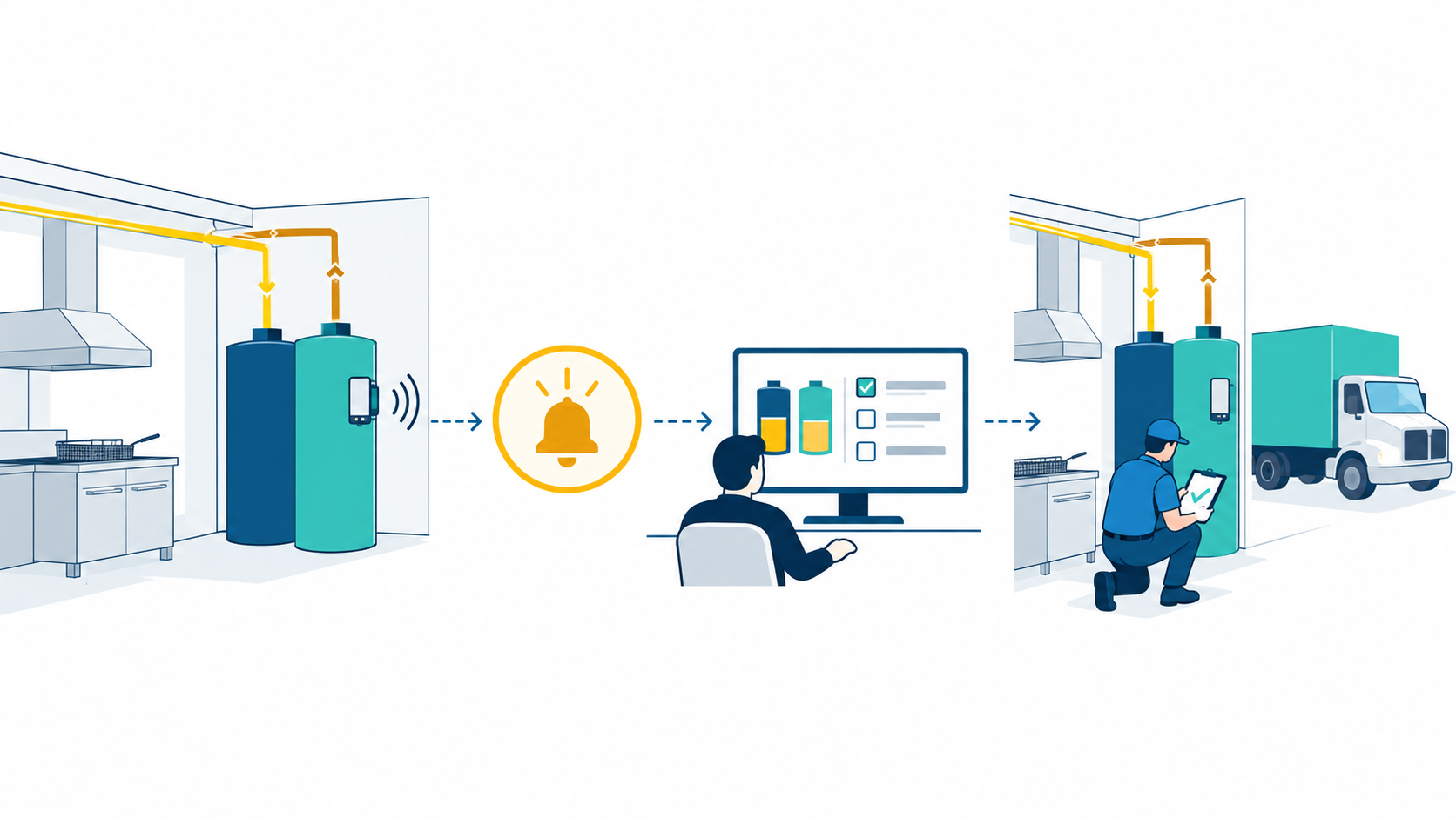
This example is limited to Sweven's currently documented tank-monitoring context. The response follows approved conditions and retains human review where the operating rules require it.
Documented signals
Approved alert conditions include configured fill-level conditions and a disconnected device. Other conditions remain assessment-led until confirmed.
A documented tank condition becomes visible.
An approved condition identifies what needs attention.
The team reviews context and follows the agreed response path.
Reorder, schedule collection, investigate connection, or document no action.
05 · The Sweven difference
Sweven is the broader maintenance operating model. IoT monitoring is one entry point connecting technology signals to operating accountability.
Supported sensors and integrations supply equipment or condition data.
Agreed operating rules carry the signal into a defined response.
People review context, approvals, exceptions, and risk.
Responsible teams and vendors perform the required work.
| Model | Primary role | Typical gap or condition |
|---|---|---|
| Hardware or sensor-only deployment | Captures equipment conditions | The client still owns triage, escalation, and maintenance response |
| Standalone monitoring dashboard | Displays alerts and trends | Action may remain disconnected from maintenance work and vendors |
| Sweven IoT monitoring | Connects signals to workflow, judgment, field action, and visibility | Scope follows supported devices, integrations, and agreed operating rules |
Strong fit
Not the right fit
06 · Questions to establish fit
Monitoring works when scope, ownership, and operating rules are clear. These are the questions the assessment resolves.
It is the use of approved equipment or environmental signals to inform a defined facilities response. Sweven connects those signals to triage, operating rules, human oversight, maintenance action, and closeout visibility.
The supported path depends on the asset, device, connectivity, and operating requirements. The assessment confirms whether a current device path, an integration, or another approved approach fits the use case.
The currently documented tank-monitoring context includes fill level, internal temperature, line/trace temperature, connection status, and approved alert conditions. All other assets, devices, integrations, protocols, and use cases are confirmed through an assessment before scope is established.
The signal follows agreed thresholds and operating rules. Depending on the configured workflow, it may be reviewed, escalated, connected to maintenance work, or documented without action.
No. Work-order behavior depends on the agreed rules, signal context, and any required human review or approval. The assessment defines those conditions before the workflow is configured.
Ownership, review, approval, and dispatch responsibilities are defined for each operating context. Human facilities judgment remains available for exceptions, approvals, and risk.
That is the intended operating model when the systems, integration path, and vendor workflow are supportable. Sweven reviews the current process during the assessment before confirming scope.
After you submit the form, a member of the Sweven team will contact you to discuss your portfolio assessment and define the appropriate next steps.
07 · Request an assessment
We'll review the assets and conditions that matter, how alerts are handled today, which systems and vendors are involved, and where the response workflow breaks down.
We've received your information. A member of the Sweven team will follow up by email to understand your operation.